Card draw simulator
| Derived from |
|---|
| None. Self-made deck here. |
| Inspiration for |
|---|
| None yet |
HungryColquhoun · 17123
Who Looks Inside, Awakes

This series provides 10 playtested decks using the Chapter 2 Core and new Starters, with each deck compatible for two player with at least 7 others (and working well at high player counts). Here Carolyn uses books to get clues while taking horror (Dreamer's Chronicle, Scroll of the Pharaohs), and then she uses other books to heal horror and get a clue from her ability (Experimental Psychology, Occult Records). Then, she uses another book (Mysterious Grimoire) to draw cards. Makes Daisy look like a rank, ill-educated freshman!
If you want to support my work, give it a like ❤︎ and a favorite ★ on here!
Series Decks
| Mystic | Rogue | Guardian | Survivor | Seeker |
|---|---|---|---|---|
| Marie | André | Tommy | Miguel | Carolyn |
| Dexter | Trish | Daniela | Izzie | Joe |
At a Glance
Stats Clue-finding: ★★★★★+ Consistency: ★★★★★ Enemy Management: ★☆☆☆☆ Encounter Defense: ★★☆☆☆ Survivability: ★★★☆☆ Simplicity: ★★★★☆
 |
 |
 |
Overview
-
Daisy's bigger, meaner sister with a library fine: This deck is painfully simple, in one hand you have either Dreamer's Chronicle or Scroll of the Pharaohs (Words of Set), in your other you have Occult Records or Experimental Psychology, and in your third hand (courtesy of University Archivist - Carolyn isn't some sort of abomination... yet) you have Mysterious Grimoire. You use the first two tomes for clue compression at the cost of horror, you use the middle two for horror healing and so a clue with Carolyn's ability (a clue with Occult Records), and you use Grimoire for card draw. Having duplicate functions in your assets makes this deck very consistent, especially with the tutoring you get from Archivist.
-
Topsy Kretts: Literary Analysis and Typewriter top-up secrets to keep your asset engine running. Typewriter is purchased late in the proposed upgrade track below, in the meantime play additional copies of tomes when you need to. To bankroll playing cards there's Private Practice and Dorothy Simmons for a dripfeed, and then Emergency Cache for periodic resource boosts.
-
Stealing from the lab: Caustic Reaction, Unflappable and Manual Dexterity (for basic evades) are your enemy management options - that's it! My advice is to pair this deck with a dedicated enemy manager; Joe, Tommy, Dexter or Daniela in this series all work well.
-
Encounter management and survivability: Manual Dexterity and Guts help with the encounter deck, but it's still a bit sparse. As such you're vulnerable to treacheries and, while horror can be healed off easily, damage is more of a bother. University Archivist is at least somewhat disposable - they're only there for a slot for Mysterious Grimoire. Once this is out of juice you can let the Archivist take their lumps! Generally Guts and Manual Dexterity are chosen over Unexpected Courage so you can better maintain card advantage (and so get cards to commit to Dreamer's Chronicle tests).
-
Weakness management: Unbroken Web is a pain, sort of like a slightly nicer Cover Up. Where Carolyn differs to Roland however is that she's very capable of getting clues. For example, a Scroll of the Pharaohs action with a Deduction committed (or using Occult Records ability immediately after the Scroll investigate) is enough to clear this with only one action spent. As Mysterious Grimoire is still the best way for Seekers to draw cards, and it will often draw Unbroken Web - you should reconcile yourself with the fact you'll deal with it (or ignore it) most scenarios!
Thank you: 5argon and their thumbnail tool; Valentin1331 for his support over the years; the community creators of Arkham.Build (Felix), Arkham Cards (zzorba) and ArkhamDB (kamalisk) - linking their Patreons!
Explain Yourself!
What will raise an eyebrow here is the large number of assets present, and I know I've made decks in the past which have drawn critique (19 assets in that case). The general benefit of having assets in a deck is they allow you to take repeat actions of the same type, rather than finding one-off events or skills that only allow you to receive a specific benefit once.
To elaborate further, you will only have 3 of the 9 of your hand assets out at any given time so you're not expected to play most of these all at once. By having overlapping assets of the same function (clue-finding, horror healing or card tutoring) the deck is more consistent - it's easier to find one of each "type" (especially with University Archivist) and so reap the benefit over several turns. With many assets here providing action compression (Dreamer's Chronicle, Scroll of the Pharaohs, Mysterious Grimoire, Occult Records) then they also in essence refund costs required to play them. Lastly, if you don't need an asset (e.g. a Private Practice you draw late, or Typewriter if you can get by without more secrets, or just a duplicate of a tome) then don't play it - any icon doubles as an extra boost with Dreamer's Chronicle after all.
In terms of cards I didn't take, no Psychoanalysis as it's deck space your asset engine doesn't allow for (and honestly upgraded Psychoanalysis is quite nice for Joe). Psychology Student remains in the deck for a little while but it phased out. Her disposable nature is very useful, but University Archivist is somewhat disposable anyway once your Grimoire is used up. I decided to not retain Perception in the deck as 25 symbols felt like enough!
Campaign starter and planned progression
0 XP deck is as follows (and link here):
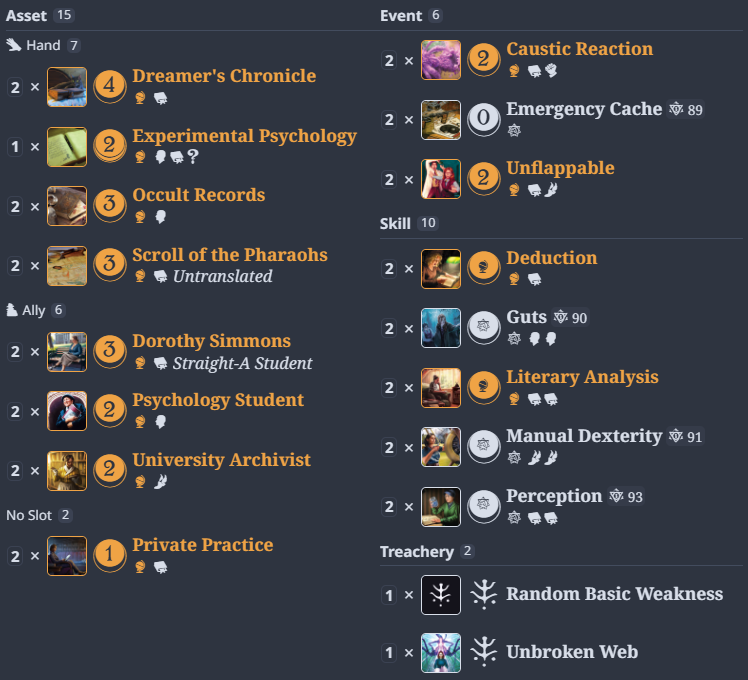
A recommended order of purchases/upgrades is:
-
1 x Scroll of the Pharaohs (Untranslated) → 1 x Scroll of the Pharaohs (Words of Set) ••••
-
1 x Scroll of the Pharaohs (Untranslated) → 1 x Scroll of the Pharaohs (Words of Set) ••••
Post-19 XP suggestions are:
Compatability Matrix
Everyone likes a good matrix! Below are all the decks that are compatible at two player using one Chapter 2 Core and one 2026 Starter Deck set:
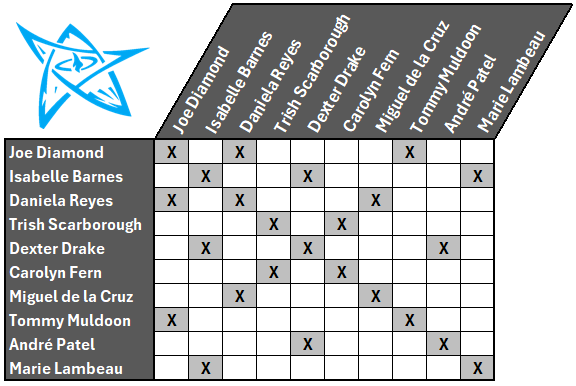
For higher player counts I've not 'compatabilized' the basic skills (Overpower, Manual Dexterity, Guts, Perception and Unexpected Courage). There are only 4 copies of each in the Chapter 2 core, enough for any two decks. If playing 3+ players and there's a clash, you can either:
-
Swap with an appropriate level 0 class skill which that deck can use (e.g. On the Brink for Unexpected Courage).
-
Swap with a class event or asset with matching or similar symbols (e.g. Working a Hunch for Perception).
-
Swap with a different underused basic skill you still believe would be useful for the deck (e.g. Guts for Unexpected Courage).
-
Proxy however you see fit (especially if you own Chapter 1 cards, just use the old school versions and remember the slight difference around who draws the card).
I empower you to do sensible things!
Final thoughts
If Joe can be considered a bit of a new wave Seeker, Carolyn is very much a return to their roots - i.e. 5 and massive clue compression on top of this. What I like about FFG's design is there's a number of complications here: there's no longer damage healing in the Seeker pool, and Seeker allies have only one damage soak. Additionally, Seekers aren't quite the card draw behemoths they once were (no more fast Cryptic Research, or massive hand sizes with Dream-Enhancing Serum) and so contingencies like Caustic Reaction are harder to access. Lastly, there's more costs associated with clue-finding, with your more effective assets having limited uses and dealing Carolyn horror.
And for me... it's great! These are all very clever ways to better balance the class. I think Carolyn is going to remain strong (as she should be), but there's a real frailty about her that you don't get with Joe. Overall FFG really nailed the brief on what a high Seeker should look like - I tip my cap!
Any thoughts - drop them below!